
Yes, stock N55 charge pipes commonly crack at the throttle-body flange after years of heat cycling. If you hear a loud whoosh under acceleration or feel a sudden loss of power, stop making hard pulls and get a pressure test before you drive it hard again. The permanent fix is replacing the plastic pipe with an aluminum unit or a correctly fitted OEM replacement, not patching the crack.
TL;DR:
- Plastic charge pipes on the N55 commonly crack near the throttle-body flange after several heat cycles, often before 100,000 miles, especially with increased boost from tuning.
- Symptoms include a loud whoosh sound during acceleration, sudden power loss, limp mode, and specific OBD codes like P0299 for underboost.
- Visual inspection, pressure testing, and scanning for boost codes are essential to confirm leaks before replacing parts.
- Upgrading to an aluminum aftermarket pipe eliminates the main failure point, particularly for tuned or high-heat driving, and requires transfer of the OEM O-ring to ensure proper sealing.
- Regular inspections at every oil change or around 60,000 miles can prevent roadside failures; factory warranty coverage is inconsistent and best supported with documented evidence.
Table of Contents
- Symptoms Of Charge Pipe Failure On The N55
- Why N55 Charge Pipes Fail: Plastic, Heat, And Stress
- How Do You Confirm A Charge Pipe Is Leaking?
- What To Do If Your Charge Pipe Fails While Driving
- OEM Replacement Vs. Aluminum Upgrade: Which Fixes It For Good
- When Should You Inspect Or Replace The Charge Pipe?
- What Happens During A Charge Pipe Replacement
- What Does A Charge Pipe Replacement Cost?
- How E9xperformanceparts Tests And Selects Charge Pipe Solutions
- Author Perspective: What Actually Matters Here
- Get The Right Parts Before You Order
- Sources
- FAQ
Symptoms Of Charge Pipe Failure On The N55
A failing charge pipe rarely stays quiet about it. The most reported symptom is an audible whoosh, flutter, or pssssh sound from under the hood during boost, especially noticeable under wide-open throttle or hard acceleration. That sound is compressed air escaping through a crack instead of reaching the throttle body, and it's often the first thing an owner notices before anything shows up on the dash.
Driveability symptoms follow close behind. You may feel a sudden loss of power under load, as if the turbo just stopped pulling, sometimes accompanied by the drivetrain warning light or a full limp mode that caps engine output. Shops that deal with this daily report the same pattern: whoosh noises, limp mode, and underboost codes show up together often enough, making it a recognizable signature for this specific failure.
Idle quality tends to suffer too. A cracked pipe upstream of the throttle body can throw off mass-air and manifold pressure readings, which shows up as a rough or hunting idle and occasional misfires, particularly when the crack is small enough to leak only under certain pressure conditions.
Expect one or more of these OBD codes when you scan the car:
- P0299: turbocharger/supercharger underboost condition
- BMW-specific boost pressure plausibility or deviation faults
- Occasional misfire codes tied to inconsistent air/fuel ratios
- Sometimes no code at all if the leak is intermittent or small
Distinguishing a charge pipe leak from an intercooler or diverter valve issue comes down to location and behavior. A charge pipe crack typically produces a sharper, more localized hiss near the firewall or throttle-body area, while intercooler boot leaks tend to sound duller and are often found lower in the engine bay. Diverter valve problems usually present as hesitation or a lag on tip-in rather than a constant leak under sustained boost.
Why N55 Charge Pipes Fail: Plastic, Heat, And Stress
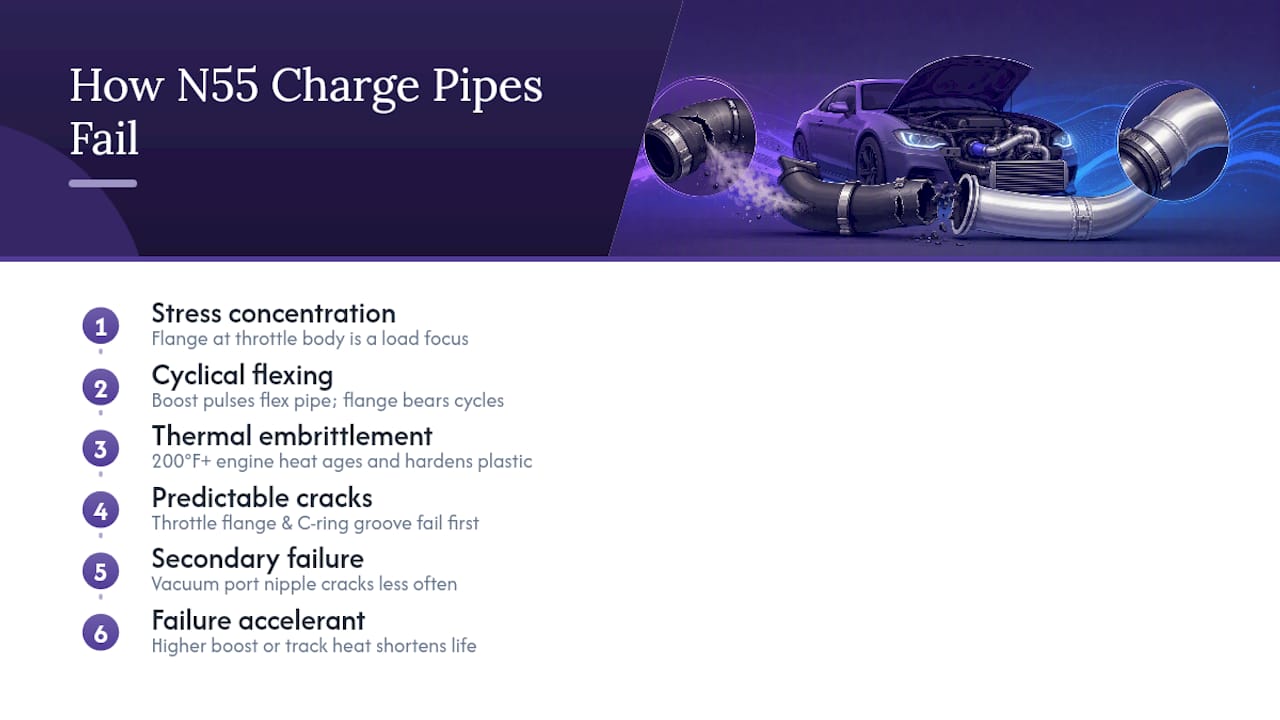
The stock N55 charge pipe is molded plastic with a welded or bonded flange where it meets the throttle body. That junction is a stress concentration point by design. Every time the engine builds boost, the pipe flexes slightly under internal pressure, and the flange takes the brunt of that cyclical load.
Heat makes it worse. The charge pipe sits in an engine bay that regularly exceeds 200 degrees Fahrenheit near the turbo and exhaust manifold, and that constant thermal cycling gradually embrittles the plastic. Over years of driving, the material loses flexibility and starts to crack rather than flex, usually at the same predictable spots.
Aftermarket technical writeups and owner reports both point to the same failure zones: the throttle-body flange and the C-ring groove crack most often, with the vacuum port nipple as a secondary weak point.
A pattern worth noting: repeated forum threads and shop write-ups describe failures concentrating at that flange after years of thermal cycling, often well before 100,000 miles, even on cars that have never seen a tune.
Raising boost through an ECU flash accelerates the timeline considerably. More boost means more radial stress on a component that was already living close to its material limit from the factory. Add engine-bay heat from aggressive driving or track use, and a pipe that might have lasted another two years under normal conditions can crack within months.
How Do You Confirm A Charge Pipe Is Leaking?
Confirming the diagnosis before you order parts saves money and prevents chasing the wrong problem. Follow these steps in order:
- Visual inspection first. Pop the engine cover and look at the plastic pipe near the throttle body. Chalky white discoloration, hairline cracks radiating from the flange, or visible warping at the clamp point are all telltale signs of a pipe on its way out.
- Pressure or smoke test. A shop or DIYer with the right adapter can pressurize the intake tract and either listen for the hiss or introduce smoke to visually spot where it escapes. This is the single most reliable way to isolate the exact failure point, and Rowlett Motor Werks recommends it specifically because so many boost-related symptoms share overlapping causes.
- Scan-tool check. Pull live data for boost pressure versus commanded boost, and watch for the actual value falling well short of target under load. Confirm whether P0299 or a manufacturer-specific boost plausibility code is stored.
- Isolate other suspects. Rule out intercooler boots, the diverter valve, and PCV or crankcase vent lines by inspecting their clamps and hose condition separately, since all three can mimic charge pipe symptoms.
Pro Tip: Don't replace the pipe based on sound alone. A cracked intercooler boot or a loose factory clamp can produce a nearly identical whoosh, and a five-minute smoke test will save you from buying a part you didn't need.
What To Do If Your Charge Pipe Fails While Driving
Your first move is to back off the throttle and avoid any hard acceleration for the rest of the drive. A cracked pipe under full boost can shed small plastic fragments into the intake tract, and pushing the engine harder increases that risk.
If the car goes into limp mode or you notice a serious loss of power accompanied by warning lights, pull over safely and shut the engine off rather than continuing to drive on it. Consider these next steps:
- Do a visual check for obvious cracks or a pipe that has fully separated from the clamp
- Avoid duct tape or silicone patch jobs as anything beyond a slow limp to the nearest safe spot
- Call for a tow if you suspect plastic debris entered the intake, since that risks turbo or engine damage
- Photograph the damage and note your current mileage before the car goes anywhere near a shop
Documentation matters here, especially if you plan to pursue a warranty claim or want a clear record for your own maintenance file. A few photos of the crack location and a screenshot of any stored OBD codes give a technician a head start and give you leverage if the dealer pushes back on coverage.
OEM Replacement Vs. Aluminum Upgrade: Which Fixes It For Good
Your three realistic options are OEM plastic replacement, an aluminum aftermarket pipe, or a silicone/reinforced coupler used as a stopgap. Each comes with different trade-offs depending on how you drive.
OEM plastic replacement puts you back to factory spec at a lower parts cost, but you're reinstalling the same material that failed the first time. Expect a similar lifespan to the original, meaning it's a reasonable choice for a low-mileage car that will stay stock, but not a long-term answer if you plan to keep the car or add power.
Aluminum aftermarket pipes solve the root problem by removing the failure-prone material entirely. Quality options feature CNC-machined flanges, mandrel-bent tubing for consistent airflow, and are often built WMI or boost-gauge ready with precapped 1/8-inch NPT ports. Direct-fit versions exist for most F-chassis N55 applications, but SKU fitment varies by chassis and drivetrain, so confirm the exact part number before ordering.
- Stock drivers, no plans to tune: OEM replacement is defensible if the car stays unmodified
- Anyone planning a tune or already tuned: aluminum upgrade is the practical choice
- Track or repeated hard-driving use: aluminum, full stop, given the repeated heat cycling
- Silicone couplers: useful as a flexible connector between hard pipe sections, less common as a full charge pipe replacement, but reasonable for a temporary bridge while you wait on the right part
Pro Tip: Whatever pipe you choose, transfer the OEM O-ring and C-clip from the old pipe to the new one. Aftermarket manufacturers stress this because a brand-new aluminum flange with a worn or missing O-ring will still leak, and it's the most common installation mistake owners make. This point comes up repeatedly in manufacturer installation guidance precisely because it gets skipped so often.
Fitment pitfalls to watch for include steering rack clearance on some chassis, offset differences on xDrive models, and forgetting the O-ring transfer entirely.
When Should You Inspect Or Replace The Charge Pipe?
A proactive inspection schedule beats waiting for a roadside failure. Here's a practical cadence:
- Every oil change or roughly 10,000 miles: visually inspect the pipe for chalky discoloration or surface cracking near the flange.
- Around 60,000 to 80,000 miles on an unmodified car: consider replacing the plastic pipe proactively, since this is the window where forum reports show failures clustering.
- Before any ECU tune or boost increase: replace the OEM plastic pipe with an aluminum unit first, not after. This is consistently the advice repeated across owner communities and aftermarket writeups.
- At every inspection: check clamp torque, look at intercooler boot condition, and confirm no oil residue is contaminating the charge pipe interior, which can accelerate material breakdown.
Warping at the flange, hairline cracks radiating outward, or any chalky white texture on the plastic are your clearest signs that replacement shouldn't wait for the next service interval.
What Happens During A Charge Pipe Replacement
A charge pipe swap is genuinely one of the more DIY-friendly jobs on the N55, typically running one to two hours of labor depending on the chassis and how much has to come off to access the pipe.
A shop doing this correctly should transfer the OEM O-ring and C-clip to the new pipe, pressure test the intake afterward to confirm the seal holds, and recheck clamp torque before calling it done. Watch for these common fitment issues:
- Steering rack clearance on certain chassis during pipe removal
- xDrive offset differences that change routing slightly
- A missing or degraded O-ring being reused instead of replaced
- Skipping the post-install road test, which should include a hard pull and a fresh scan for stored codes
What Does A Charge Pipe Replacement Cost?
Parts pricing depends heavily on which route you take. OEM plastic replacements sit at the lower end, while quality aluminum upgrades with fresh O-rings typically run a few hundred dollars in parts, plus labor if you're not doing it yourself.
Worth knowing: shops that see this failure regularly recommend pressure testing before ordering any part, since a misdiagnosed leak elsewhere in the intake tract means wasted labor and a part you didn't need.
- OEM plastic pipe: lower parts cost, similar failure risk down the road
- Aluminum aftermarket pipe: higher upfront cost, removes the recurring failure mode
- Labor: generally one to two hours if no complications arise
On warranty, forum evidence is mixed. Some owners have gotten dealers to cover the failure as a defect, especially on cars still under factory or extended coverage, while others report dealers treating it as a wear item and denying the claim outright. Document mileage, take photos of the crack, and keep service records handy before you walk into a service department. That paper trail is often the difference between a covered repair and a bill you pay yourself, which is part of why plenty of owners skip the warranty argument entirely and just install a durable aluminum pipe.
How E9xperformanceparts Tests And Selects Charge Pipe Solutions
Parts curated for E9x and compatible N55/N54 applications often include checking fitment details that generic listings might skip. Every part we feature gets evaluated for O-ring sealing compatibility, throttle-body clearance, and whether it actually matches the SKU variations across different N55 model years.
That attention matters because a charge pipe that fits an E90 335i doesn't necessarily bolt straight onto an E92 with the same engine. Our technical guides, including the E90 intake and exhaust breakdown, exist so owners can cross-reference their exact chassis before ordering.
Owners researching charge pipe upgrades consistently ask the same question first: will this actually fit my car without modification. That's the question our fitment notes are built to answer.
- Fitment verified against chassis and drivetrain variant before a product goes live
- O-ring and clamp compatibility checked against OEM specifications
- Technical support available for owners unsure which SKU matches their build
Author Perspective: What Actually Matters Here
Upgrade before you raise boost, not after a failure forces your hand. That's the clearest lesson from years of forum threads and shop reports: the plastic pipe was never going to survive sustained higher pressure, tune or no tune. Warranty coverage is real and worth pursuing, especially with photos and mileage documented, but don't count on it. For most owners, an aluminum pipe installed once, correctly, with the OEM O-ring transferred, is the better long-term value than repeated plastic replacements.
— lesley
Get The Right Parts Before You Order
Fitment checked specifically against E9x and compatible N55 chassis variants before the part ships adds assurance beyond a generic parts search. That matters when a charge pipe, coupler, or clamp kit needs to match your exact drivetrain, not just your engine code.

Beyond charge pipe hardware, our catalog covers engine-bay upgrades that pair naturally with a durable intake repair, including reinforced silicone coolant hoses and related N54 engine guidance if your build shares components across platforms. Browse the full E9x parts catalog to see what's compatible with your chassis, and if you're unsure whether a specific pipe or clamp kit fits your VIN and drivetrain configuration, contact our technical support team before you check out. Getting fitment confirmed up front beats returning a part that looked right on paper.
Sources
For deeper technical detail, STR Performance's charge pipe writeup covers material failure and upgrade rationale. Rowlett Motor Werks explains shop-level diagnostics. The Bimmerpost thread documents real owner experiences and should be read as anecdotal, not definitive.
- Ultimate Guide: Why your BMW N55's charge pipe will break (and how to save your engine)! - STR Performance
- BMW Charge Pipe & Boost Leaks (N20/N55) in Texas Heat - Rowlett Motor Werks
- Another Stock N55 Charge Pipe Failure - Bimmerpost forum thread
FAQ
What Are The Symptoms Of A Broken Charge Pipe?
A loud whoosh or hissing sound under acceleration, sudden power loss under load, rough idle, and stored codes like P0299 are the most common signs of a cracked N55 charge pipe.
What Are Some Common Failures With The BMW N55 Engine?
Beyond the charge pipe, N55 owners commonly report waste gate rattle, oil filter housing gasket leaks, and ignition coil failures, though the charge pipe remains one of the most frequently discussed issues on owner forums.
Is There An OEM Charge Pipe For A BMW N55 Engine?
Yes, BMW sells an OEM plastic replacement pipe, but it uses the same material that failed originally, so many owners choose an aluminum aftermarket pipe instead for a longer-lasting fix.
Can I Drive With A Broken Charge Pipe?
You can drive cautiously at low load to reach a shop, but avoid hard acceleration entirely, since continued boost pressure through a crack risks further damage and potential debris entering the intake tract.
How Do I Know If My Charge Pipe Needs Preventive Replacement?
Chalky discoloration, hairline cracks near the flange, or a car approaching 60,000 to 80,000 miles without prior replacement are strong signals to replace the pipe before it fails on its own.